FIELD SURVEY 07 · LIVE MAP

Hunt liquidity terrain.

Fill the taxonomy before the rare shapes disappear.
Floating terrain specimen
LIVE FIELD · {{ openSlots }} OPEN SLOTS MOVE THE POINTER TO TILT
Hunt console SLOT COUNTS {{ countStr }}/12
RDGBSNSPRARCFLDPLT
NEXT FORM · {{ target.id }} · GRADE {{ target.grade }}
{{ target.name }}
depth {{ target.depth }} · slope {{ target.slope }} · facets {{ target.facets }}
First slot opens without a lock.
{{ homeNote }}
Continue in the map →
02 · FIELD SIGNAL

TVL growth creates new forms

A 9.8 % rise in seven days across 155 protocols has produced fresh liquidity shapes worth archiving.

9.8%
TVL RISE · 7 DAYS
155
PROTOCOLS SURVEYED
Terrain profile 7 D · ILLUSTRATIVE
D1D2D3D4D5D6D7
TVL depth New forms surfaced
03 · THE HUNT

Move through the map. Lock what you find.

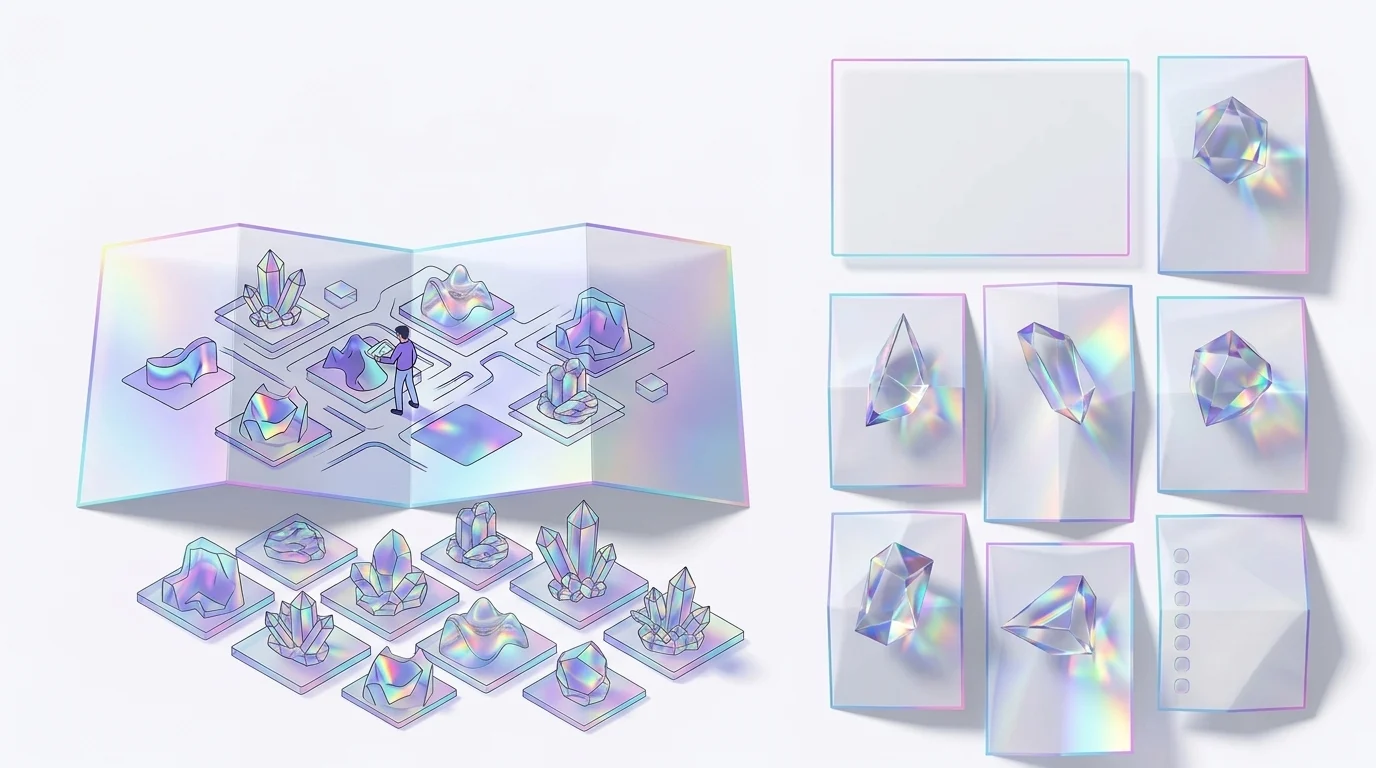
Every liquidity form sits on a tile in a spatial map. Move across it, read each specimen's shape descriptors, then align the refraction to lock the form into an open taxonomy slot.
01
Move
Drag across the map or pick a node from the rail. Search by family, grade or ID.
02
Read
Hover a specimen for its tag. Select it to open its shape descriptors and target slot.
03
Capture
A needle sweeps the spectrum. Lock it inside the bright window and the form settles into its slot.
04 · SLOT COUNTS

Each addition makes the next slot rarer.

The first slot opens wide. By the twelfth, the refraction window is a sliver and the odds sit at 1 in 377.

{{ countStr }} /12
{{ l.n }}
{{ l.label }}
{{ l.win }}
Enter the map →
Progress stays in this browser.
MORPH INDEX · FIELD SURVEY 07 ALL FIGURES ILLUSTRATIVE
{{ n.name }}
{{ n.id }}
{{ n.name }}
{{ n.tag }}
{{ matchCount }}/18
FIRST HUNT
Start with {{ ob.id }} · {{ ob.name }}.
Its slot window is wide and the needle moves slowly. Select it, press Capture, then Lock while the needle sits inside the bright window.
DRAG TO MOVE · SCROLL TO ZOOM · SPACE TO LOCK
{{ p.id }} · GRADE {{ p.grade }} · {{ p.famCode }}
{{ p.name }}
{{ p.note }}
SPIN {{ p.spin }} {{ p.stateLabel }}
SHAPE DESCRIPTORS
DEPTH
{{ p.depth }}
SLOPE
{{ p.slope }}
FACETS
{{ p.facets }}
FIELD
{{ p.field }}
SIGNAL · RELOCATES AT ZERO{{ p.decay }} S
TARGET SLOT {{ p.slotLabel }} · {{ p.slotState }}
WINDOW {{ p.win }}NEXT SLOT 1 IN {{ nextOdds }}
ASSIST ON · WINDOW WIDENED AFTER TWO SLIPS
ALIGN THE REFRACTIONWINDOW {{ p.win }}
SPACE TO LOCK
Aligned
Splitting the form into spectral bands. Locking into {{ p.slotLabel }}.
FAILED LOCK
Slipped
Off by {{ p.off }}. The form moved to a new tile. {{ p.missText }}
NO OPEN SLOT
{{ p.slotLabel }} already holds {{ p.holdBy }}. A second {{ p.famName }} of Grade {{ p.grade }} has nowhere to go.
DORMANT · {{ p.dormantSecs }} S
Three slips put the form to rest. It can be captured again when the count reaches zero.
ARCHIVED
Held in {{ p.slotLabel }}. Filled at 1 in {{ p.heldOdds }}. {{ p.okNote }}
SAME FAMILY · LINKED ON MAP
TAXONOMY
{{ countStr }} /12 slot counts
NEXT SLOT
1 in {{ nextOdds }}
WINDOW · GRADE I
{{ nextWin }}
Select a specimen on the map or in the rail. Each family holds one Grade I and one Grade III slot. Grade III forms lose signal and relocate.
SLOT COUNTS {{ countStr }}/12
{{ sl.label }} {{ sl.odds }}
TAXONOMY COMPLETE
12 of 12 slot counts.
Every family and grade is archived. The last slot filled at 1 in 377.
HOW IT WORKS

A field guide to the taxonomy.

Morph Index reads liquidity as terrain. When depth shifts across protocols it settles into forms with measurable shape descriptors. Collectors hunt those forms on a spatial map and archive one of each kind into twelve slots.

01
Move
Drag across the map, zoom with the wheel or the controls, or pick a node from the rail. Search by family, grade or ID.
02
Read
Hover a specimen to see its tag. Select it to open its shape descriptors, its target slot and the forms it links to.
03
Lock
Press Capture. A needle sweeps the spectrum; press Lock or Space while it sits inside the bright window.
04
Archive
The form splits into spectral bands and settles into its slot. The next window is narrower and the odds climb.
Shape descriptors
DEPTHShare of the form's volume held below its median line, 0.00 to 1.00.
SLOPEAngle of the steepest face, in degrees.
FACETSDistinct planar faces after smoothing.
SPINRotation rate of the specimen in the field.
GRADEGrade I forms are stable. Grade III forms are rare, lose signal and relocate.
When a capture fails
SLIPPEDThe needle stopped outside the window. The form moves to a new tile. After two slips the window widens.
SLOT FILLEDThat family and grade already hold a specimen.
DORMANTThree slips in a row. The form rests for 15 seconds.
DECAYEDA Grade III signal ran out and the form relocated elsewhere on the map.
Slot counts, step by step
{{ countStr }}/12 FILLED IN THIS BROWSER
FILLWINDOW · IWINDOW · IIIODDSSTATUS
{{ l.n }}{{ l.win }}{{ l.win3 }}{{ l.label }}{{ l.status }}
All figures on this site are illustrative. Progress is saved in this browser only.
Enter the map →